
Why Construction Site Inspection Needs a New Approach?
On an active construction site, safety is rarely hard to manage because nobody is walking the site. It is hard to manage because the site itself is so complex.
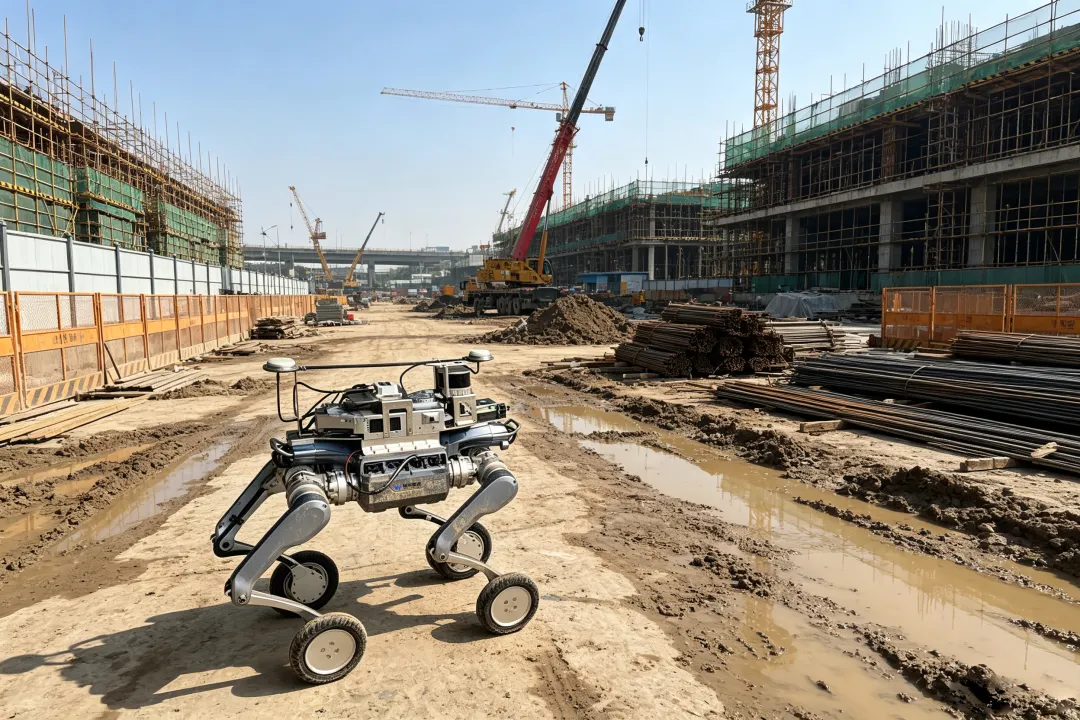
On an active construction site, safety is rarely hard to manage because nobody is walking the site. It is hard to manage because the site itself is so complex.
Rebar, scaffolding, stockpiled materials, heavy plant, cabling, open excavations: all of it changes as the build progresses. A route that was clear yesterday may be an active work zone today, and a walkway that has just been cleared can be blocked with materials an hour later.
A construction site is also a dense, constantly moving mix of people, machinery and materials. Traditional inspection by people on foot is running into clear limits in this environment.
01 Why Site Inspection Matters
From groundbreaking to handover, a construction project changes continuously. Each phase brings new people, equipment, materials and temporary structures. Risk isn't fixed. It moves as the work moves.
Site inspection therefore does three essential jobs:
Identify issues. Are access routes blocked? Is edge protection intact? Are materials stored correctly? Is any equipment behaving abnormally? Have new hazards appeared in the work zone?
Record change. Inspection means more than a quick look. It needs photos, video, location and timestamps, so there is evidence for corrective action and ongoing management.
Close the loop. Finding a hazard is only the first step. It then needs to be logged, assigned to the responsible person, tracked through remediation, and checked again.
Construction inspection robots are now moving beyond simple data capture toward this full loop: inspect → identify → report → remediate.
So why has such important work relied almost entirely on people? Because construction sites are complex, and that complexity is exactly what makes manual inspection so difficult.
02 The Built-In Limits of Manual Inspection
People bring experience, judgement and the ability to make decisions on the spot. Human stamina, attention and working patterns still have hard limits, and these are gaps traditional inspection can't avoid.
1. Inspection is itself high-risk work
To find hazards, inspectors first have to expose themselves to them.
Deep excavations, tower crane bases, lower scaffold levels, slope retention, confined service tunnels and tunnel faces are exactly where falls from height, collapses, falling objects and toxic gas incidents are most likely. Routine inspection means entering these areas again and again.
It gets harder at night, during overtime shifts and over holiday shutdowns, when staffing is thin. Full coverage on foot is slow and labour-intensive, and entry to high-risk areas often needs a permit first, which delays the response.
2. Places you can't reach become blind spots
A construction site can cover tens of thousands of square metres across scattered zones and difficult terrain. One full walk of the site can take hours.
Around 80% of an inspector's effort goes into walking, observing and working around obstacles, which leaves only about 20% for analysis and decisions.
As the site grows, remote areas, elevated work faces and excavation floors easily become blind spots. Managers are constantly trading off inspection frequency, coverage and headcount.
This is where robot dogs help. They turn human walking time into productive machine inspection time. The robot handles routine data capture, and safety staff focus on dealing with risk, where their engineering experience and judgement count most.
Blind spots usually exist because an area can't be reached, not because nobody wants to check it. When a hazard sits in one, it becomes a ticking time bomb.
3. There are gaps in time
Manual inspection happens in rounds and shifts. Site risk changes continuously. Shift changes, lunch breaks and night work often go unsupervised. An area that was clear in the morning can hold a new hazard a few hours later.
Unsafe behaviour, such as missing PPE or unauthorised hot work, is hard to stop as it happens. Most of it is dealt with only after an incident.
Good safety management aims to find and fix hazards straight away. Manual inspection can often only react after the fact, and that delay is where incidents happen.
A robot changes inspection from "whenever someone has time" to scheduled, fixed-point, repeatable missions. That is why robots suit routine inspection work so well.
4. Subjective judgement causes missed hazards
Quality checks and hazard identification depend heavily on individual experience. Two safety officers can judge the same task very differently. Is the scaffold compliant? Is the shoring adequate? Are the controls sufficient? Without consistent, measurable criteria, it comes down to experience and a good eye.
Long, repetitive rounds also cause fatigue and loss of attention. A safety officer who walks 20,000 steps a day is noticeably less sharp and alert by the afternoon. That is a physical limit, and asking people to be more careful doesn't fix it.
5. Siloed data can't support informed decisions
Traditional inspection records live in paper forms and photo folders. They are fragmented, inconsistent and hard to trace, so systematic analysis is almost impossible.
Logging, assigning, remediating and verifying hazards all move by hand. The process is slow, fixes are delayed, and the same hazards keep coming back. With feedback scattered across channels, it is hard to see which areas have the most hazards, which tasks keep failing, or which subcontractors have weak safety practices.
You can't manage what you don't measure, and you can't manage it well without structured data.
6. Adding more people gives diminishing returns
To cover more ground and inspect more often, contractors keep adding safety staff. Labour costs rise in a straight line, but safety outcomes don't improve at the same rate.
Coverage, attention span and accuracy all have a ceiling, so input and output fall out of balance.
03 Intelligent Inspection That Moves Past These Limits
Quadruped and wheeled robots, often called robot dogs, don't simply replace people on construction sites. They change how inspection works at a fundamental level.
The value doesn't come from a robot walking around the site with a camera on its back. For the first time, the site gets a mobile, intelligent platform that senses continuously, repeats tasks reliably, avoids obstacles on its own and keeps a digital record of everything.
1. Unmanned inspection of high-risk areas
This is the core value: inspectors no longer need to enter dangerous areas to do their job.
Using LiDAR and multi-sensor visual fusion for localisation, the robot detects temporary stockpiles, debris and other obstacles as they appear, and plans a new route around them. It can reach the same work faces a person can, and go further into deep excavations, tunnel faces and confined service tunnels, removing the physical blind spots of traditional inspection.
In GPS-denied environments such as underground tunnels and utility corridors, semantic mapping combined with odometry and point-cloud localisation lets the robot move smoothly between above-ground and underground areas while navigating on its own.
It also supports private network communications. If the connection drops, all inspection data is cached locally and uploaded automatically once the link is back. This prevents data loss in the weak-signal conditions common on sites and in tunnels.
The highest goal of safety management isn't keeping people safe while they work in hazardous areas. It is making sure they don't have to go there at all, and robot dogs are making that possible.
2. 24/7 operation in all conditions
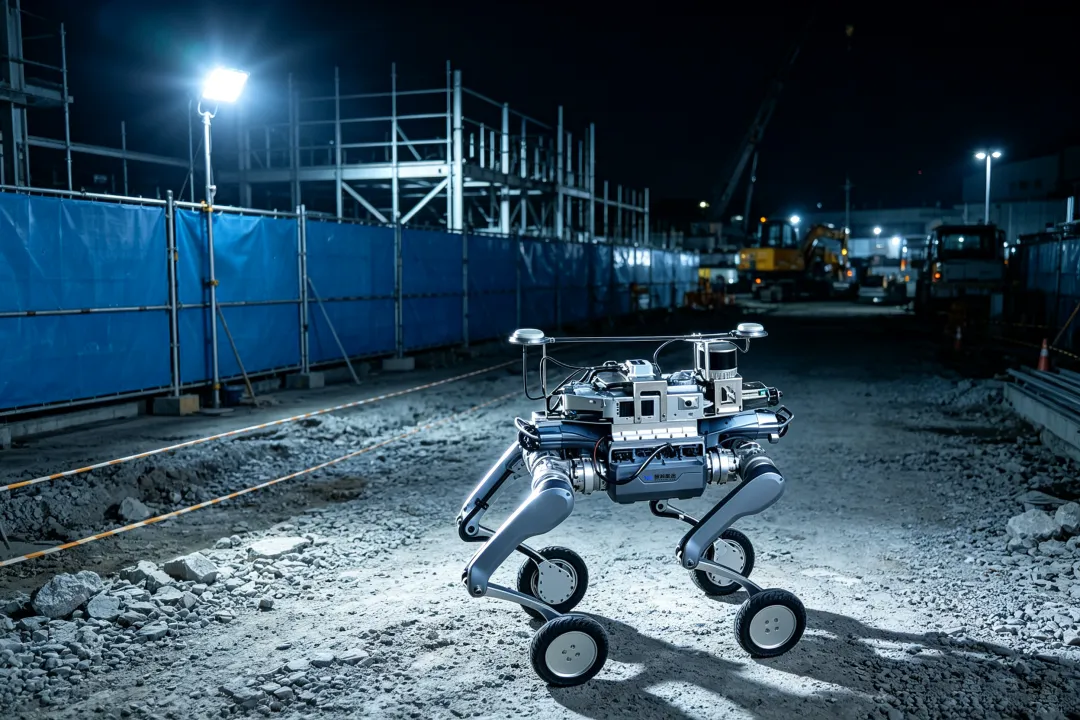
With autonomous scheduling, the robot runs missions on preset routes and frequencies without remote control. It covers the periods where supervision is traditionally weakest: night works, shift changes and holiday shutdowns.
Periodic manual rounds become high-frequency, continuous monitoring. That closes the time gaps in traditional inspection and moves safety management from fixing problems afterwards to finding them in real time.
3. Hazard identification that is standardised, improvable and traceable
The robot can carry LiDAR, 360° cameras, thermal imaging and other sensors, paired with AI. The platform supports sample management, auto-labelling, distributed training and simulation-based evaluation, with models tuned for construction environments. Each project can quickly retrain its detection models for its own risk profile, so accuracy improves the more the system is used.
Detection covers several areas:
- Worker compliance: hard hats, hi-vis vests, harnesses, smoking on site
- Structural risk: scaffold deformation, cracks in shoring, steel arch spacing deviations
- Environmental monitoring: toxic or hazardous gases, water ingress and leaks, open flame and smoke
Inspection data from the robots flows into a central management platform. Over time, it supports higher-level management decisions.
Traditional inspection produces loose written notes. Robot inspection produces standardised, structured data and a continuous record of how the site changes. That data connects to project management platforms and digital twin systems, forming the data foundation of a smart construction site. Hazard identification moves from depending on each safety officer's experience to a single, consistent algorithmic standard.
4. Greater efficiency and management reach
Industry field results show robot inspection can improve inspection efficiency by 2–3× and cut related labour costs by up to 70%.
Just as important, the robot frees safety officers from walking so they can focus on assessment and decisions, where people add the most value. A safety officer who used to cover 3 zones a day can now monitor 10 at once with robot support, which greatly extends each manager's reach.
With intelligent robot inspection, site safety shifts from people-based to technology-enabled protection, from experience-driven to data-driven management, and from reacting after incidents to early warning.
04 Our Approach
At BotsDeploy, we believe a robot's value isn't in showing off technology. It is in solving real problems.
Construction inspection is a clear example of a real problem. The pain points are obvious, the need is non-negotiable, and customers are willing to pay. Quadruped robot technology has now matured to the point where it can be deployed at scale.
We start from the use case, not the product. We don't build a generic platform and then look for somewhere to use it. We go onto the site, learn how inspection really works, where it breaks down and what teams need, and only then define the hardware, software and interaction design.
From obstacle avoidance and path planning to AI hazard detection, and from data upload to closed-loop management, every feature has to answer one question: does this solve a real problem for the contractor?
For deployment, we focus on light setup and fast results. Construction projects run to fixed timelines, so robotics can't become a heavy, long-term capital burden. With standardised deployment, modular features and a flexible Robotics-as-a-Service (RaaS) model, contractors get the most safety benefit at the lowest cost within the life of their project.
Conclusion
New technology usually starts with the most dangerous and repetitive work, and site inspection fits that exactly. Too many incidents show that tragedy is often avoidable. What failed was a management approach that couldn't keep up with the project's complexity.
When robot dogs can patrol every corner around the clock without tiring, when AI can identify hazards with over 95% accuracy, and when data flows back in real time to support better decisions, we have a real chance to bring the incident rate down.