
Getting a Robot Past the Boardroom: How NZ Operators Build the Case for Autonomous Patrol & Inspection
Most robot projects don't fail on site. They fail in a meeting room. Here's the five-step playbook we use with NZ operators to get from cool demo to approved pilot.
Most robot projects don't fail on site. They fail in a meeting room, three weeks before anyone has seen the robot walk.
An operations lead sees a quadruped climb stairs at a trade show, comes back fired up, and pitches it to the GM. The answer is some version of "interesting — what does it cost and what do we get?" Without a crisp answer, the idea drifts into next year's budget cycle and quietly dies.
Boston Dynamics made the same observation after hundreds of Spot deployments: the single biggest unlock isn't the hardware, it's support from the top — because that's what releases budget, people and site access. We see exactly the same thing in New Zealand. So here is the playbook we use with customers to get an autonomous patrol or inspection project from "cool demo" to "approved pilot."
01 Find Where a Robot Actually Earns Its Keep
Start with the work, not the robot. Walk your site and list the tasks that are:
- Dangerous: plant rooms, substations, wet stockpile lanes at night, anywhere you'd rather not send a person alone at 2am.
- Repetitive: the same patrol route, the same gauge readings, the same thermal checks on the same switchboards, every shift.
- Hard to staff: overnight posts with chronic turnover, remote sites that need a two-hour drive for a ten-minute check.
In NZ that list usually lands on three use cases: overnight perimeter patrol, routine plant inspection (thermal, visual, acoustic), and remote eyes-on for sites that are expensive to visit. Don't overthink this stage. A whiteboard session with your site supervisor and security lead is enough.
02 Split ROI into Direct and Indirect
Executives respond to numbers, but the full value of a robot shows up in two layers.
Direct ROI — the one-to-one savings you can put in a spreadsheet:
- Overtime and backfill on overnight security shifts
- Travel time and vehicle costs to remote or after-hours sites
- Contractor call-outs for inspections the robot can now perform
Indirect ROI — harder to quantify, often bigger:
- Catching faults earlier because you collect data every night instead of every quarter
- Fewer people exposed to hazardous zones (a real line item under the Health and Safety at Work Act 2015)
- An audit-ready log of every patrol and every anomaly
- Your best people redeployed from walking fence lines to solving problems
Most business cases only argue the first list. The second list is what gets a COO leaning forward.
03 Write a One-Paragraph Value Hypothesis
Narrow your shortlist to the one use case that is both valuable and achievable in 90 days. Skip the wishlist items — a robot that opens doors, reads every meter and talks to visitors is a year-three conversation.
Then compress it into a single paragraph your leadership team can read in 30 seconds:
"We'll deploy two autonomous robots on the overnight perimeter route at [site] for 6 months. We expect to cut overnight overtime by [X]%, log 100% of scheduled patrols, and flag thermal anomalies on [N] switchboards weekly. Success = [metric] by month 3."
Alongside it, list what you need: a project owner, a budget line, and access to a real site. That's it.
04 Pitch It Against Company Goals, Not Robot Specs
Nobody on the leadership team cares about degrees of freedom or lidar range. They care about:
- Safety targets: fewer people in harm's way after dark
- Opex: security and maintenance budgets that keep climbing
- Uptime: catching the overheating motor before it trips the line
- Risk and compliance: evidence that patrols and inspections actually happened
Frame the robot as an answer to one of those. Then answer the two questions every executive will ask: what's the payback? and how soon will we see it? A defined pilot, a timeline and a success metric answer both.
05 Where New Zealand Is Different — and Why a Service Model Changes the Conversation
The overseas playbook assumes an innovation team with a development budget, Python developers and a capital line for six-figure hardware. Most NZ operators don't have that — and they shouldn't need it.
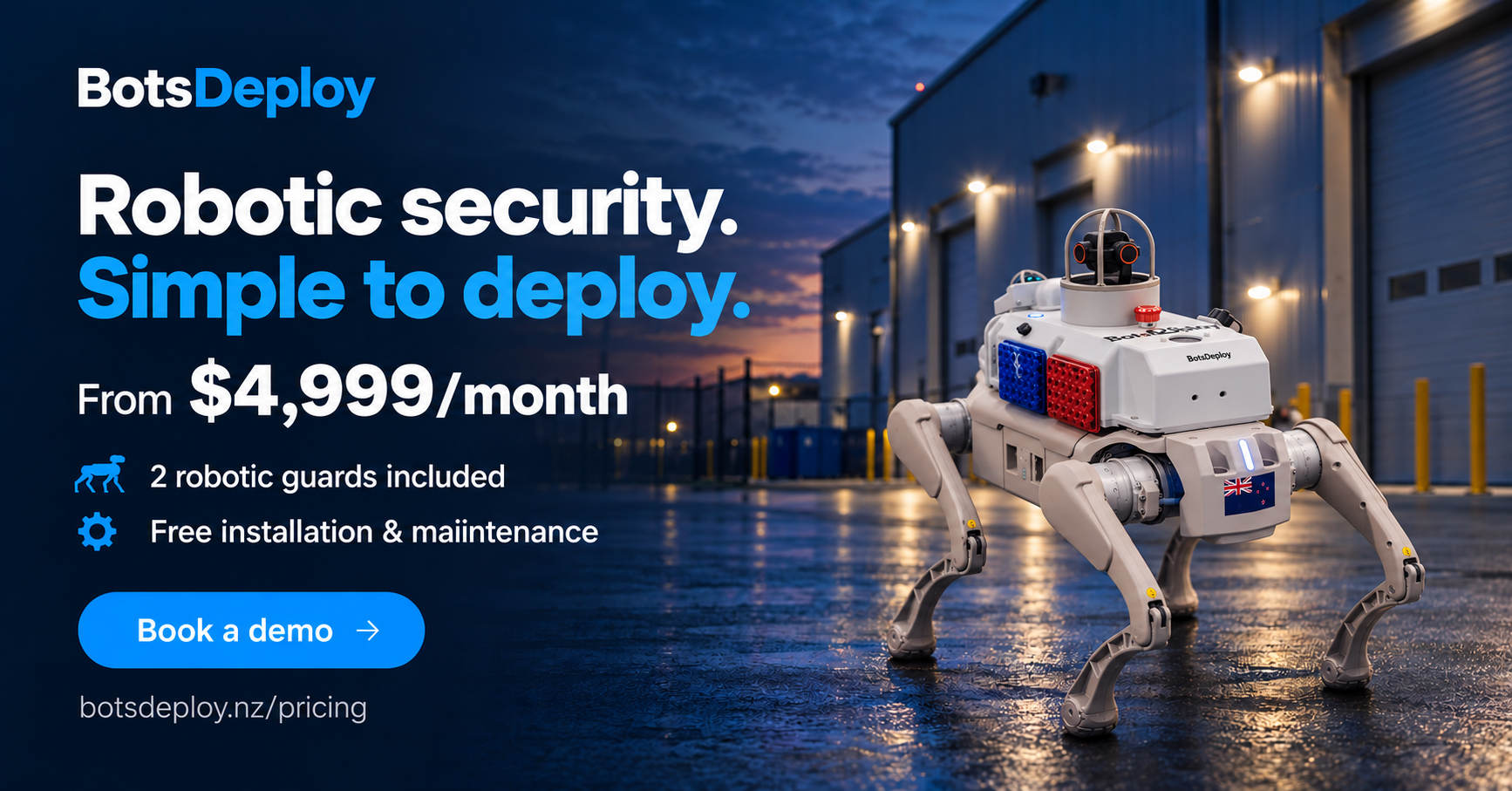
That's why BotsDeploy runs as a service. Instead of asking the board for capex, you're asking for an operating line item that sits next to your existing security or maintenance contract.
Our base package is $4,999 + GST per month and includes:
- Two robotic security guards and two fixed charging stations
- Deterrence monitoring, 8 hours a day, 7 days a week
- Free installation and maintenance
- Integration with your existing cameras
Then add what your site needs: 24/7 autonomous patrols, inspection intelligence (thermal checks, gauge reading, leak detection), advanced AI detection, or extra robots. If you'd rather run it yourself, you can buy the units and operate them with your own security team.
For the executive, that reframes the decision. It's no longer "buy a robot and hope." It's "run a pilot at a known monthly cost, measure it against overtime and call-outs, and decide with data." See the full package at botsdeploy.nz/pricing.
The Short Version
- List dangerous, repetitive and hard-to-staff tasks.
- Map direct and indirect ROI.
- Pick one achievable use case and write a one-paragraph hypothesis.
- Pitch it against company goals with a pilot, a timeline and a metric.
- Remove the capex objection with a service model.
The robot is the easy part. Getting the right people to say yes is the project.
---
Book a site walkthrough. Send us your site plan and the task you'd most like off your roster — we'll help you draft the value hypothesis and a pilot plan you can take straight to your leadership team. botsdeploy.nz
Inspired by Boston Dynamics' blog on engaging executives for agile mobile robot deployments.